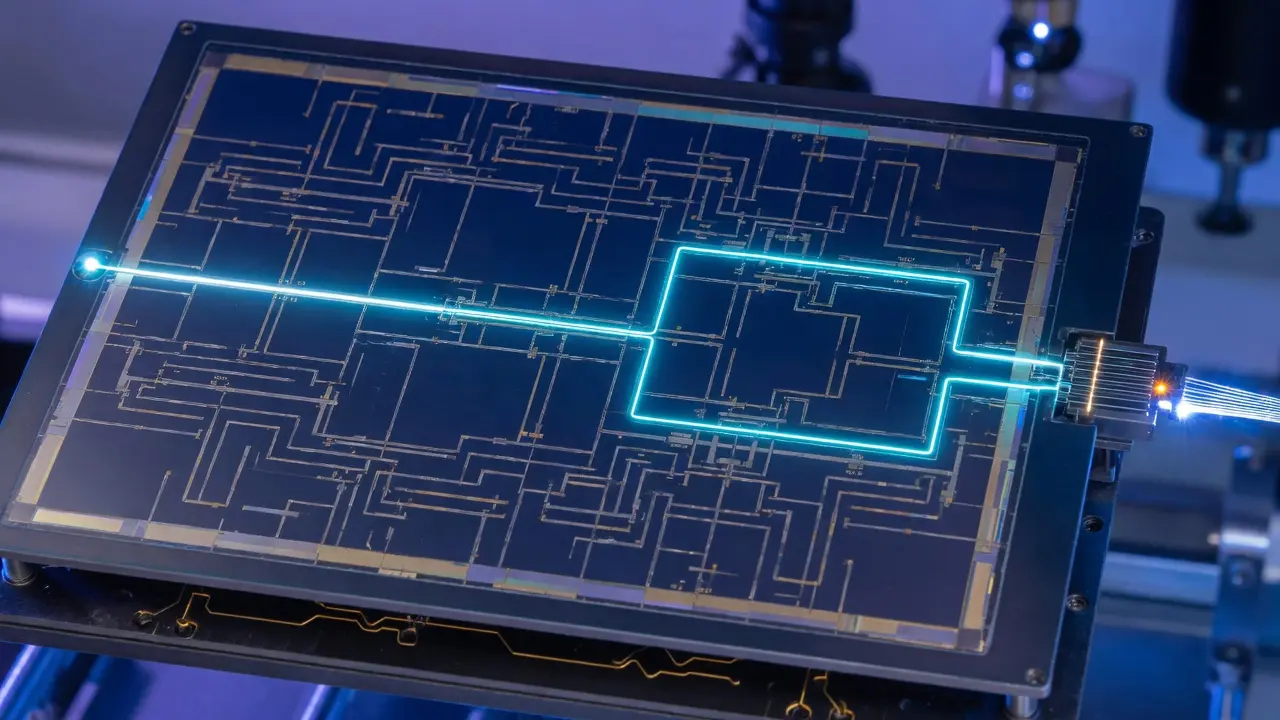
Manav Seksaria, Advith Desu and Anil Prabhakar of the Indian Institute of Technology Madras and the Singapore University of Technology and Design report a method for predetermining optimal variational quantum circuit structure. Their work establishes three rules that fix choices of circuit design, ansätze and depths, from data and the gate set alone, before any training begins.
A singular value decomposition of a dataset’s Fourier coefficients indicates whether entanglement is needed, identifying which qubits should connect, while the rank of the quantum Fisher information matrix grows predictably with circuit depth. For the Madelon dataset, these rules prescribed a 239-parameter classifier with 78.5% test accuracy, found without a grid search.
Data-Driven Entanglement Detection via Fourier Coefficient Analysis
This approach bypasses traditional methods of searching for optimal circuit designs, or ansätze and depths through trial and error. The analysis centers on the rank of the Fourier coefficient tensor, revealing whether a circuit lacking entangling gates can accurately represent the data; a rank exceeding one on any qubit subset signals the need for entanglement. From a labelled dataset, it decides whether a product ansatz can represent the target and, if not, which qubits must be entangled.
The rank of the quantum Fisher information matrix grows by p₀ per layer, after a first-layer deficit d₀, until it reaches a ceiling set by the dynamical Lie algebra. The study highlights a surprising efficiency in measurement strategy.
Reading out all Pauli-Z products from a single batch of shots resolves half of the state’s directions, the most any single-basis readout can. A single-qubit readout resolves an exponentially small fraction. Ablation studies confirmed the predicted effects of shallower circuits, smaller qubit blocks and the reduced accuracy resulting from omitting re-uploading. “For the Madelon dataset, the rules prescribe 7 blocks of 3 qubits at depth 3,” the researchers state, demonstrating the practical application of their data-driven approach to circuit design.
QFIM Rank Growth Defines Optimal Circuit Depth
The team’s analysis reveals that the QFIM rank climbs by p₀ per layer after an initial deficit d₀, a pattern observed even before circuit training begins. This predictable growth stems from the fundamental way circuits manipulate quantum states.
The QFIM itself measures how much a circuit’s output state changes with variations in its parameters. Its rank, therefore, indicates the number of independent directions in which those parameters can steer the state. The DLA, a concept from Lie algebra theory, defines an upper bound on this rank, reflecting the inherent limitations of the chosen gate set and initial state.
This suggests a systematic way to build circuits with increasing expressive power, guided by the QFIM’s predictable trajectory. The team’s approach differs from traditional methods by focusing on analytical rules that determine circuit choices before any training occurs, streamlining the design process and potentially reducing computational costs. The work also connects circuit design to the concept of representability, examining whether a circuit can even produce certain target functions.
A circuit’s ability to represent a function is linked to the Fourier coefficient tensors of that function, and the best rank-one approximation error of these tensors provides a lower bound on the mean squared error of any product ansatz. The study’s framework considers three stages of information flow within a VQC: encoding, state preparation, and readout. Each stage is governed by a distinct consideration, representability, QFIM rank and extraction ratio, which provides a comprehensive approach to circuit optimization.
The extraction ratio ρ measures how much of the state a VQC can effectively use during the readout phase, further refining the design process. By addressing these considerations in sequence, the researchers aim to establish a set of rules that can reliably prescribe optimal circuit configurations for a given dataset and gate set. The team’s methodology moves beyond simply identifying if entanglement is needed, to pinpointing which qubits should be connected.
This is achieved through an analysis of the Fourier coefficient tensors, which reveal the necessary entanglement structure for a given problem. This targeted approach contrasts with more general entanglement strategies, potentially leading to more efficient and effective results.
Pauli-Z Extraction Ratio Limits Readout Efficiency
The work establishes that this limit isn’t merely theoretical. But a quantifiable boundary on how effectively a variational quantum circuit (VQC) can use its prepared state during the readout phase. The concept of an “extraction ratio”, defined as the number of linearly independent operators in a readout divided by the minimum of the circuit’s orbit-stabiliser ceiling and the dimension of the pure-state manifold, provides a precise measure of this use.
Researchers found that, for an ansatz fully using its representational capacity, a complete Pauli-Z readout achieves an extraction ratio of 1/2, regardless of the number of qubits. This means that even as quantum systems scale, the efficiency of this particular measurement strategy remains constant, a surprising result given the exponential growth in state space. Proposition 2 formally states this finding. This ceiling on readout efficiency is particularly relevant when considering the broader framework for optimizing VQC design.
The researchers note that the orbit-stabiliser ceiling, Crank, caps the dimension a given ansatz can actually reach, with Crank ≤ dimM, where dimM represents the dimension of the projective pure-state manifold. The interplay between these factors, QFIM rank, the dynamical Lie algebra and the extraction ratio, is important for building efficient VQC’s. The work demonstrates that even with a perfectly expressive ansatz, the ultimate limit on information extraction is set by the chosen readout basis.
The researchers emphasize that the analysis is currently restricted to pure states, leaving the exploration of noisy circuits for future work. The extraction ratio ρ is defined as nobs / min(Crank, dimM), providing a quantifiable metric for assessing readout efficiency.
Representability Constraints of Product Ansatz Circuits
A circuit lacking entangling gates possesses a rank-one Fourier coefficient tensor on any subset of qubits, a constraint that dictates whether entanglement is necessary for accurate representation and identifies which qubits should interact. This allows for pre-determination of circuit structure before any training begins, offering a significant reduction in computational overhead. For instance, the trigonometric polynomial cos(x₀ + x₁), with its rank-two Fourier coefficient matrix, cannot be perfectly reproduced by any product ansatz, regardless of depth.
The analysis extends beyond simply identifying the need for entanglement. It quantifies the error incurred by omitting it. By calculating the best rank-one approximation error, denoted ρ₁(C*(S)), researchers can determine the minimum error achievable with a product ansatz, providing a benchmark for evaluating circuit performance. This metric is calculated on the torus , a normalized space where the circuit output is 2π-periodic in every coordinate, ensuring a consistent error measurement.
The dynamical Lie algebra, g, generated by the circuit’s operators, sets an upper limit on this growth, defining a ceiling beyond which additional layers offer no benefit. The specific values of p₀ and d₀ are dependent on the chosen gate set and coupling architecture, as detailed in the appended table, which outlines these parameters for various ansatz types, including product, N-local and Brickwork circuits. However, the established constraints on representability and circuit depth provide a solid foundation for developing more efficient and accurate variational quantum algorithms.
Encoding with Ry Rotations and Input Coordinate Mapping
reveals a relationship between circuit structure and the initial data. The work demonstrates that the number of parameters added per layer, denoted p₀, scales with the block size, specifically two parameters per qubit within a given block. A block size of three qubits, for example, necessitates a depth of three layers to achieve full rank, while a block of five qubits requires seven layers, according to the established equations.
The analysis further clarifies that the dynamical Lie algebra, which governs the circuit’s operators, sets a ceiling on the growth of the quantum Fisher information matrix rank, defining the maximum achievable dimensionality of the pure-state manifold. This merging reduces the effective parameter count used in the rank law, using only 2*s* parameters where s represents the block size, despite the total parameter count being 3*s*.
This observation is key to accurately predicting the circuit’s representational capacity and optimizing the balance between parameter efficiency and expressive power. “Eq. (26) fixes L at a given block size s,” the study notes, referring to the equation that determines the optimal circuit depth based on block size and rank saturation.
Dynamical Lie Algebra Sets Ceiling on QFIM Rank
The rank of a quantum circuit’s quantum Fisher information matrix (QFIM) increases predictably with each layer added, until it hits a ceiling dictated by the circuit’s dynamical Lie algebra, according to new work. The QFIM itself is the metric defining the map from parameters to states, with its entries measuring how much the output state changes when parameters are varied together. This means the dimension of the orbit of the initial state, |0⟩, under the circuit’s transformations determines the maximum achievable QFIM rank.
The study details how this orbit-stabiliser theorem provides a means of calculating this ceiling, offering a theoretical framework for understanding circuit complexity. It has practical implications for circuit design.
The researchers found that the dimension of the orbit, and therefore the QFIM rank, is bounded by the dimension of the DLA minus the dimension of the subalgebra that fixes the initial state. As an example, they examined a hardware-efficient ansatz (HEA) on three qubits with a CX chain, illustrating how the DLA constrains the achievable rank. The work also builds on the understanding that parameter count can overestimate the number of independent directions a state can move.
The QFIM rank provides a more accurate measure, accounting for redundancy in the parameter space. This is particularly relevant as circuits grow in complexity, where the number of parameters can quickly outpace the number of truly independent directions. The study notes that the researchers demonstrate a diagnostic tool that can determine whether entanglement is necessary in a circuit before any training begins.
By performing a singular value decomposition on the dataset’s Fourier coefficients, the method identifies which qubits should be connected, and provides a lower bound on the error of omitting entanglement. By providing a quantifiable ceiling on circuit complexity, this work offers a valuable tool for researchers and engineers working to advance quantum computation.
👉 More information
🗞 Data informed Ansatz Selection for Variational Quantum Circuits
✍️ Manav Seksaria, Advith Desu and Anil Prabhakar ([)
🧠 ArXiv: https://arxiv.org/abs/2611.05079


See today’s quantum computing news on Quantum Zeitgeist for the latest breakthroughs in qubits, hardware, algorithms, and industry deals.